| |
The Life and Work of St. John of the Cross
Life.
Juan de Yepes was born in 1542 in Fontiveros (Ávila) into a very humble family that would eventually move to Medina del Campo, fleeing from poverty. There, Juan received a deeply religious and humanistic education, ultimately entering the Carmelite Order, where he took the name of Juan de Santo Matía.
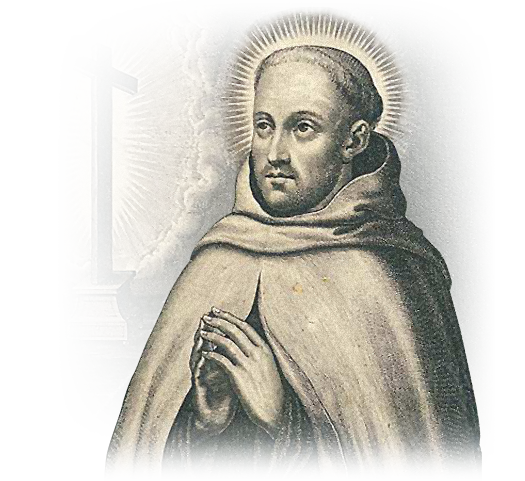
After completing his studies at the University of Salamanca and being ordained as a priest, he returned to Medina del Campo, where he met St. Teresa in a transcendental meeting in which the nun persuaded him to undertake the reform of the male order of Carmelites. St. Teresa said that Friar Juan was one of the purest and holiest souls in God’s Church, and that he possessed great treasures of light, purity and wisdom from Heaven.
In 1568, Friar Juan and Friar Antonio de Jesús, with the help of Mother Teresa, founded the first male community of the reform in the small village of Duruelo, very close to Mancera, marking the beginning of the male order of Discalced Carmelites. There, Juan professed the Primitive Rule of Carmel and became known as Friar John of the Cross.
In Duruelo, Friar Juan took care of the house and the instruction of the novices, while Friar Antonio spent his time preaching in nearby places, which led him to meet Don Luis de Toledo, Lord of Mancera, who invited him to preach in the local church and proposed that he move the community to Mancera, which he did in 1570.
In Mancera, and without Friar Antonio de Jesús, John of the Cross received the professions of the first two friars to enter the male Discalced Carmelites on 8 October 1570.
The future saint lived in the monastery for barely a year, and there is no record of his return, but both Mancera and Duruelo had a profound influence on his life and literary work.
From Mancera, Friar Juan left for Alcalá de Henares to take up the post of rector of the first college founded by the reform. Sometime later he moved to Avila to work as a spiritual educator of nuns until he was arrested by the Carmelites of the old order and imprisoned for eight months in a dungeon in Toledo, where he came very close to dying.
He finally escaped to Andalusia, where he continued his work for ten years. The last stage of his life was spent in Segovia, and he died in Úbeda (Jaén) in 1591.
Unlike the ascetics who withdraw from society, mystics such as St. John of the Cross and St. Teresa of Jesus immersed themselves in the societies where they lived. They travelled constantly, founding and reforming communities and serving as spiritual guides to the population, but never abandoning a contemplative life of solitude and penance that allowed them direct and momentary union with God.
The work of St. John of the Cross
St. John of the Cross, a saint and doctor of the Universal Church, is one of the most notable figures of the Spanish Golden Age, with a brief but brilliant body of work, fully framed in a renaissance far removed from other clerical texts and medieval tradition. In it, spirituality and love walk hand in hand through passions that burn or wound both body and soul the same way as would fire, storms, rain, hail or snow. Many of his verses are spiritual writings derived from his experiences of union with God and reflect a pure and immortal soul struggling to escape from the prison of the body, which deceives it with pleasure and pain.
St. John began writing in Avila during the years when he lived with St. Teresa, enriching both of them and mutually conditioning their literary production. It was there that the Carmelite composed some of his best known poems, such as Vivo sin vivir en mí (I Live without Living in Me) and Entréme donde no sabé (I Entered where I Did Not Know).
This life that I live
is deprivation of living,
and so it is continuous dying,
until I live with you:
hear what I say, my God,
I do not want this life,
I am dying because I do not die.
I Live without Living in Me. St. John of the Cross.
Another key moment in the work of the future saint was his imprisonment in Toledo, during which he wrote some of his best texts: the first stanzas of the Spiritual Canticle, The Fountain and the Romances on the Gospel.
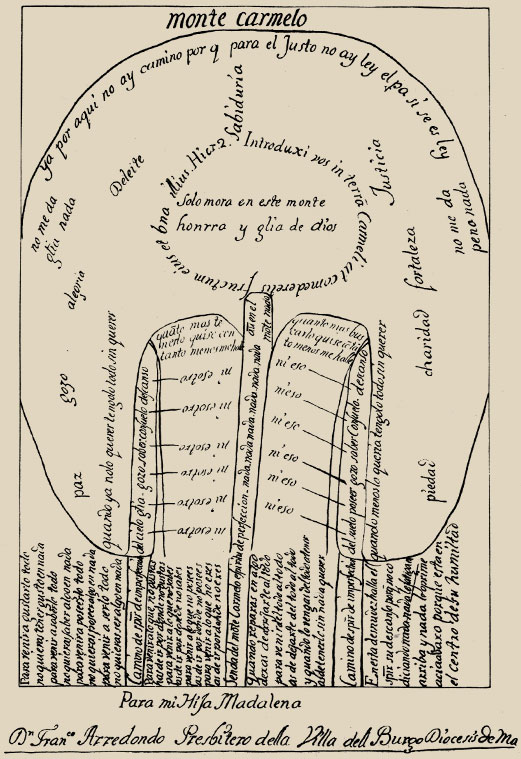
But it was in Granada where he wrote most of his compositions. When he arrived there in 1582, he had already begun his most extensive work, The Ascent of Mount Carmel, which he never finished. During those years he finished The Spiritual Canticle and wrote The Living Flame of Love, as well as The Dark Night, which is also unfinished.
St. John was named the patron saint of Spanish poets by John Paul II, and his writings, which came to light after his death, have become fundamental works of universal mystical literature. |
|
|
|
|